
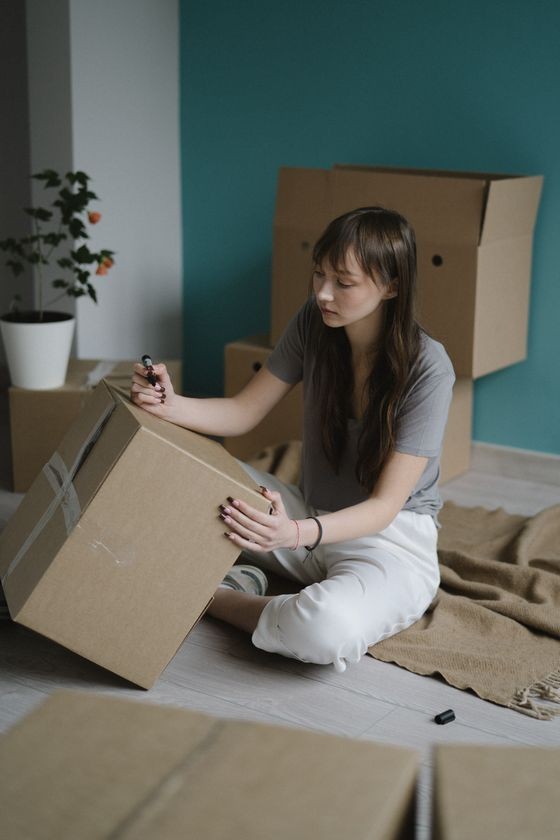
A clear label is what gets a box into the right room on moving day. In a Malaysian condo or landed house, several rooms can look alike once the furniture is out, and movers are often working fast in a tight corridor, a shared service lift or a staircase with a box in both hands. If they can read where a box belongs from a few steps away, it goes straight to that room instead of into a pile by the front door. The system below takes one evening to set up: a room code in English and Bahasa Malaysia, a colour for each room, a short contents line with a box number, a handling mark only where it is true, and one first-night box that travels with you.
This guide is about how to label boxes for moving, not how to wrap plates or fill a carton. For that, use our step-by-step packing guide and these packing and organising tips. Prefer Malay? Our packing guide is also available in Bahasa Malaysia: Cara Kemas Barang Pindah Rumah.
1. Why Labelling Matters on a Malaysian House Move
Most moving-day mix-ups are not lost boxes but boxes in the wrong place: bedroom cartons in the kitchen, kitchen cartons blocking the bathroom, and a first night spent moving them again.
A few things make labelling more important here than the generic advice suggests:
- Shared lifts and corridors. In a high-rise, boxes often wait in a lift lobby or along a corridor before they go in. A label on the side, not just the top, is the only one anyone can see in a stack.
- Two languages on the same job. Crews, family members and helpers may read English, Bahasa Malaysia or both. A bilingual room name removes the guesswork.
- Rooms that look the same. Once a house is empty, “Bedroom 2” and “Bedroom 3” are just two white rooms. A code and a colour on the door solve that.
- Time limits. Many buildings give you a fixed slot for the service lift or loading bay. Every minute spent asking “where does this go?” comes out of that slot.
2. Set Up Your System Before You Tape the First Box
The biggest labelling mistake is starting to write on boxes before you have decided what to write. Spend fifteen minutes on these three decisions first, and write them down on one sheet of paper.
Agree the room names
List every room or area at the new home, not the old one, because that is where the boxes are going. Give each one a short name in English and Bahasa Malaysia. Keep the names the whole family will actually say out loud.
Pick one colour per room
Choose a colour for each room and stick to it. Coloured tape, coloured stickers or a thick coloured marker all work. What matters is that each colour means one room only. If you run out of distinct colours, use a colour plus a letter (for example, blue A and blue B).
Choose a numbering style
Number boxes per room, not across the whole house. “KITCHEN / DAPUR 3 of 8” tells everyone exactly how many kitchen boxes there should be. You will know at a glance when one is missing.
Here is an example key. Use your own rooms and colours.
| Room code (EN / BM) | Colour | Example label |
|---|---|---|
| MASTER / BILIK TIDUR UTAMA | Blue | MASTER / BILIK TIDUR UTAMA 2 of 6 |
| KIDS / BILIK ANAK | Green | KIDS / BILIK ANAK 1 of 5 |
| BED 3 / BILIK TIDUR 3 | Purple | BED 3 / BILIK TIDUR 3 4 of 4 |
| KITCHEN / DAPUR | Red | KITCHEN / DAPUR 3 of 8 |
| LIVING / RUANG TAMU | Yellow | LIVING / RUANG TAMU 5 of 7 |
| BATHROOM / BILIK AIR | Orange | BATHROOM / BILIK AIR 1 of 2 |
| STORE / STOR | Grey or black | STORE / STOR 2 of 3 |
Have a few thick waterproof markers and a roll of tape ready before you start. Waterproof ink matters in Malaysia: a sudden afternoon downpour on moving day can smudge an ordinary pen label in minutes. You do not need any special product. Plain markers, masking tape and a sheet of paper are enough.
3. What to Write on Every Box
Each box needs four things, in this order of size: the room, the number, the contents and, only if needed, a handling mark.
- Room code, in capitals, in English and Bahasa Malaysia. This is the biggest text on the box. For example: KITCHEN / DAPUR.
- Box number and room total. For example: 3 of 8. If you add boxes later, update the total on the key sheet and on the last box.
- A short contents line. Two to five words: “pots and pans”, “school books”, “towels and bedsheets”. You are telling someone where it goes and roughly what is inside, not writing an inventory.
- A handling mark, only if it is true. FRAGILE, THIS WAY UP or DO NOT STACK. See section 5.
Write the room code and number on at least two sides and the top. When boxes are stacked against a wall or loaded on a trolley, the top is often hidden. When they are on the lorry, the sides may be hidden. Two sides and the top covers most positions.
If you like, add your phone number to a few key boxes only, such as the first-night box, in case one is set down in the wrong stack at the building.
4. Colour Marks That Work in a Corridor or Lift
Words work up close. Colour works from a distance, which is exactly what you need when a mover is carrying a box past a row of open doors.
- Mark two sides and the top with a strip of coloured tape or a large colour block, at least the size of your palm. A small dot is easy to miss.
- Put the colour in the same place on every box, for example the top-right corner of each side. People learn the pattern within a few boxes.
- Tape the room key to each door at the new home. On the door of the master bedroom, put a sheet with the blue colour, the words MASTER / BILIK TIDUR UTAMA and, if you like, an arrow. Do the same for every room, including the store and bathroom.
- Keep the key bilingual. The door signs should match the box labels word for word.
5. Fragile, This Way Up and Do Not Stack
Handling marks only work if people trust them. If every box says FRAGILE, nobody treats any of them differently. Keep these marks for the boxes that truly need them.
| Mark | Use it for | Do not use it for |
|---|---|---|
| FRAGILE | Glassware, mirrors, ceramics, picture frames, small electronics | Books, clothes, linen, toys |
| THIS WAY UP (with an arrow) | Boxes with open bottles, plants, items that must stay upright | Boxes that can go any way up |
| DO NOT STACK | Boxes that could crush if something heavy sits on them | Sturdy boxes of books or tools |
| HEAVY | Boxes that need two people or a trolley | Light boxes, so the word keeps its meaning |
A few more habits help:
- Draw arrows on all four sides for THIS WAY UP, and write FRAGILE in a different colour from the room colour.
- Do not list chemical names on the outside. For a box of cleaning products, write the room and “cleaning supplies, keep upright” instead. Keep caps tight and the box upright.
- Large appliances are a separate topic. Fridges, washing machines and TVs need their own preparation, which we cover in our guide to moving a fridge or washing machine.
If you want more detail on wrapping delicate items, see our guide to handling fragile and valuable items during a move.
6. The Open-First or First-Night Box
After a long moving day, nobody wants to open eight boxes to find a phone charger. Pack one clearly marked box or bag with what you will need on the first night and the next morning, and keep it with you rather than in the general stack.
Label it differently from everything else so nobody loads it by mistake. For example, write OPEN FIRST / BUKA DULU on every side in large letters, and use a colour that no room uses. A typical first-night box might hold:
- toiletries, a towel and toilet paper for each person
- phone chargers and a power strip
- a change of clothes and any medication
- a kettle, a few cups and simple snacks
- basic tools: a box cutter, scissors, a screwdriver and tape
- bedsheets for the first night
Important documents and valuables go in a separate bag that stays on you. That is covered in the next section. For the rest of your packing list, our step-by-step packing guide has the details, so we will not repeat it here.
👉 Planning a house move and want a quote? WhatsApp TheLorry: 017-200 5401
7. What Not to Write on the Outside of a Box
A label is meant to help the people carrying the box, but anyone else who sees it can read it too, including people in a shared lift lobby or a loading bay. Keep the outside boring.
- No passport or IC numbers, bank details or anything you would not want a stranger to copy.
- No jewellery lists and no words like “gold”, “cash” or “watches”.
- No brand or model names of electronics, such as “contains laptop” or “camera”. Write “office, desk items” instead.
- No full inventory of valuables. If you want a record of what is in each box, keep it on your own paper list (section 9), not on the carton.
Valuables, cash, important documents and small expensive electronics should travel with you, not in a box. Treat the outside of the box as a delivery label, not a catalogue.
8. Share the System With Your Movers
A labelling system only helps if the crew knows it exists. Before the first box leaves the old home:
- Show the key sheet to whoever is leading the crew. Point out the colours, the room names and the OPEN FIRST box.
- Walk them through the new home’s layout if you can, or send a simple sketch with each room’s colour. At the new home, the door signs do the rest.
- Say which boxes need care. Point to the FRAGILE and DO NOT STACK boxes so they can be loaded sensibly.
- Keep one person at each end. At the new home, have someone near the entrance who can glance at a colour and send each box to the right room.
If either home is a condo or apartment, the building will have its own rules for service lifts, loading bays and moving hours. Those come from the management office, JMB or MC, not from TheLorry. You apply for any moving permit and pay any building deposit yourself, as our FAQ on moving permits explains. Book your lift slot first, then plan your labels so boxes can move through that slot quickly.
9. A Simple Inventory You Can Keep on Paper
You do not need an app or a spreadsheet. A single sheet of paper, or a page in a notebook, is enough for most homes. Draw five columns:
| Box no. | Room (EN / BM) | Short contents | Handling | Arrived? |
|---|---|---|---|---|
| 1 of 8 | KITCHEN / DAPUR | pots and pans | HEAVY | ☐ |
| 2 of 8 | KITCHEN / DAPUR | glasses and mugs | FRAGILE | ☐ |
| 1 of 6 | MASTER / BILIK TIDUR UTAMA | bedsheets, towels | – | ☐ |
| 1 of 1 | OPEN FIRST / BUKA DULU | first-night items | Travels with me | ☐ |
Fill in each row as you seal a box. On moving day, tick “Arrived?” as each box reaches its room. At the end of the day, count the ticks per room. If the kitchen shows 7 of 8, you know exactly which number to look for.
Take a photo of the sheet with your phone before moving day, in case the paper goes missing.
10. Common Labelling Mistakes to Avoid
- Labelling by the old home’s rooms. Use the new home’s rooms. “Old study” means nothing when the study items are going into a bedroom.
- Writing only on the top. Stacked boxes hide the top. Use two sides and the top.
- Small handwriting. Write the room code big enough to read from about two metres away.
- Reusing old boxes without crossing out old labels. Black out or tape over any old writing completely, or the box may go to the wrong room.
11. How TheLorry Can Help
Once your boxes are labelled, the move itself is the easy part to book. Our House Moving Packages start from RM368 including SST, covering the first 30 km from pickup to drop-off, for homes in Peninsular Malaysia excluding the islands, Sabah and Sarawak. See the package page for what each package includes, or message us with both addresses for a quote.
Show the crew your key sheet when they arrive and they can follow your labels from the first box to the last.
12. Frequently Asked Questions
What should I write on a moving box?
Write the room name in English and Bahasa Malaysia, a short contents line, the box number for that room (for example, 3 of 8), and a handling mark only if it is needed, such as FRAGILE or THIS WAY UP. Put the room and number on at least two sides and the top.
Should I label boxes in English or Bahasa Malaysia?
Use both for room names, for example KITCHEN / DAPUR. A bilingual room code is easier for mixed crews and for family members who use different languages. Make the door signs at the new home match the boxes exactly.
Do I need colour-coded labels?
They are not compulsory, but colour marks on two sides and the top help a lot in a lift lobby or corridor, where people can see colour from a distance. They only work if you also tape a colour-to-room key on each door at the new home.
What is an open-first or first-night box?
It is one clearly marked box or bag of essentials for the first night and next morning, such as toiletries, chargers, a change of clothes, medication and basic tools. Keep it with you rather than loading it into the general stack.
Should I list valuables on the box?
No. Keep jewellery, cash, important documents and small expensive electronics with you, and do not advertise them on the carton. Write a neutral contents line such as “office, desk items” instead.
Will TheLorry’s movers read my labels?
Labels help any crew work faster. Share your room key at the start of the job, keep labels large and on more than one side, and put matching signs on the doors. If you are moving into or out of a high-rise, remember that TheLorry does not apply for building moving permits or pay building deposits; the permit FAQ explains this.
13. Conclusion
Knowing how to label boxes for moving comes down to four habits:
- Code: room name in English and Bahasa Malaysia, plus the box number for that room.
- Colour: one colour per room, on two sides and the top, with matching signs on the new home’s doors.
- First night: one OPEN FIRST / BUKA DULU box that travels with you.
- Inventory: one sheet of paper you tick off as boxes arrive.
Set it up in an evening, show it to your crew on the day, and your boxes will find their rooms on the first try. When you are ready, get a house moving quote for your move.
👉 Ready to book your move? WhatsApp TheLorry: 017-200 5401